
Bumble Inc. Safety by Design
Safety toolkit of resources and processes to help teams consider safety
Year
2023 - 2024
Deliverable
Internal product programme
Role
Staff Product Designer
Contributions
Product & service strategy, Programme development
Background
Safety By Design was a Bumble Inc. wide initiative aimed at helping product and engineering teams embed safety considerations into everything they build.
All products can be misused or lead to unintended behaviors that put users at risk - especially in the online dating space. In this role, I partnered closely with my Product Lead to establish a structured internal approach. This included developing processes to proactively identify and mitigate potential safety risks from the earliest stages of product development through to launch.

How might we create a set of self-service processes & resources so that Bumble inc. teams can proactively consider safety in their products & features?
Key Product & Features:
Product & Design teams as participants + stakeholders
Establishing a framework of the product development lifecycle
Tool developed: Safety Evaluation
Tools developed: Safety Risk Workshop Template
Product & Design teams as participants + stakeholders
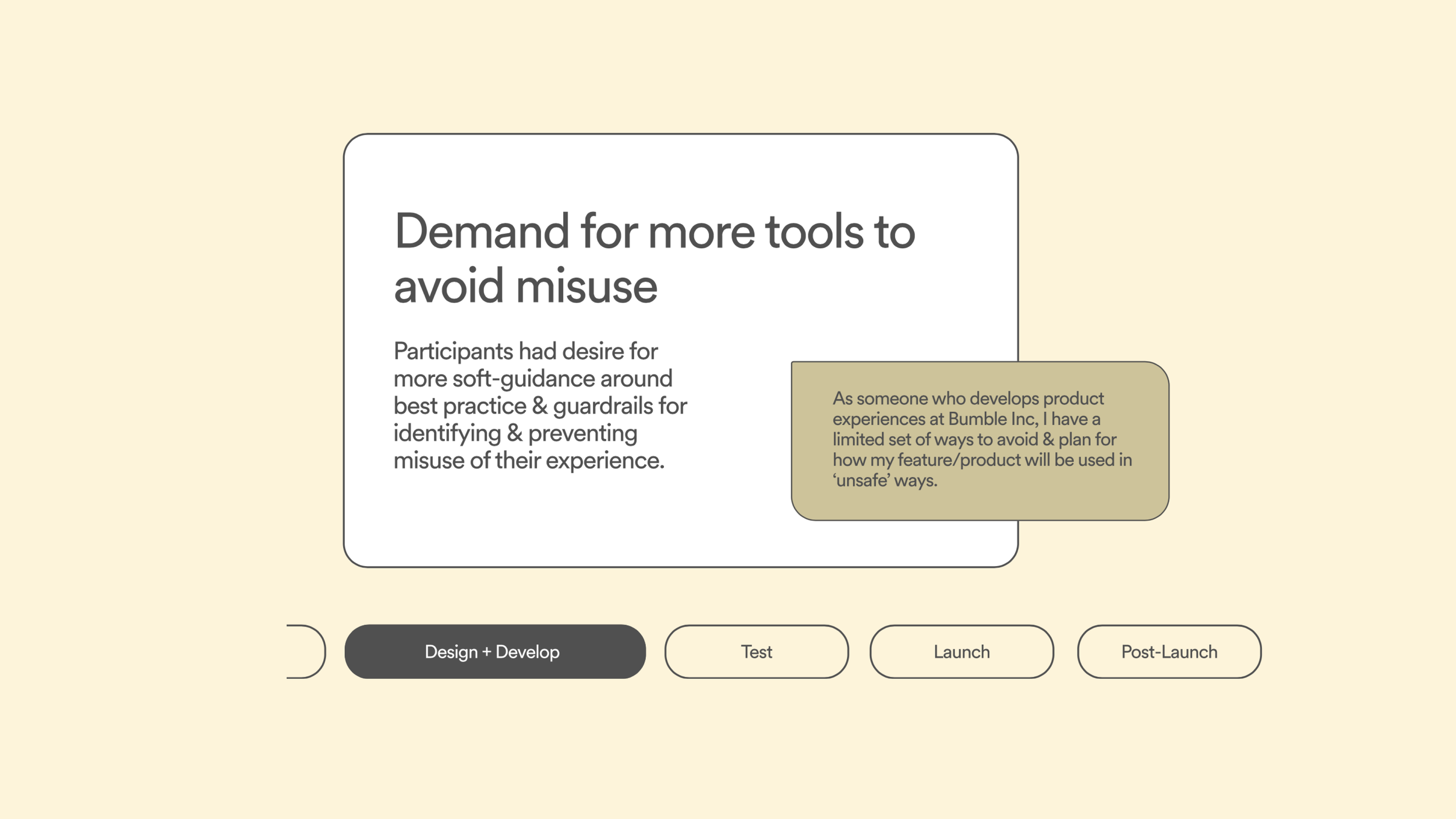
This was a 0-1 effort without existing structures to build from. As a result, a series of workshops were run with internal design and product teams who articulated challenges when seeking to develop features with safety proactively in mind. Some examples of problems & opportunities identified were:
Need for risk severity tiers and types
Clearer set of data metrics, guardrails, and thresholds to implement and track
Overlapping review processes with Brand, Legal and Compliance
Awareness of existing safety integrations & features
Establishing a framework of the product development lifecycle
These problems and opportunities were mapped at different moments within the lifecycle of creating and building a new feature/product. This reflected different needs at different times, and pointed to a multi-pronged approach that broke down into:
Risk Evaluation and scoring system
Recommendations plan
Integrated safety metrics that teams are required to use
Plug-and-play safety features like reporting, verification flows and pro-social nudges
Key Features
Safety Evaluation
The structural backbone of the company-wide program. This is an automated questionnaire for teams to fill out and receive customised recommendations based on their answers. Recommendations include: integration of existing safety user-facing features and machine-learning detections - a requirement when dealing with public facing user-generated content like photos, videos, and written text.
Safety Risk Workshop Template
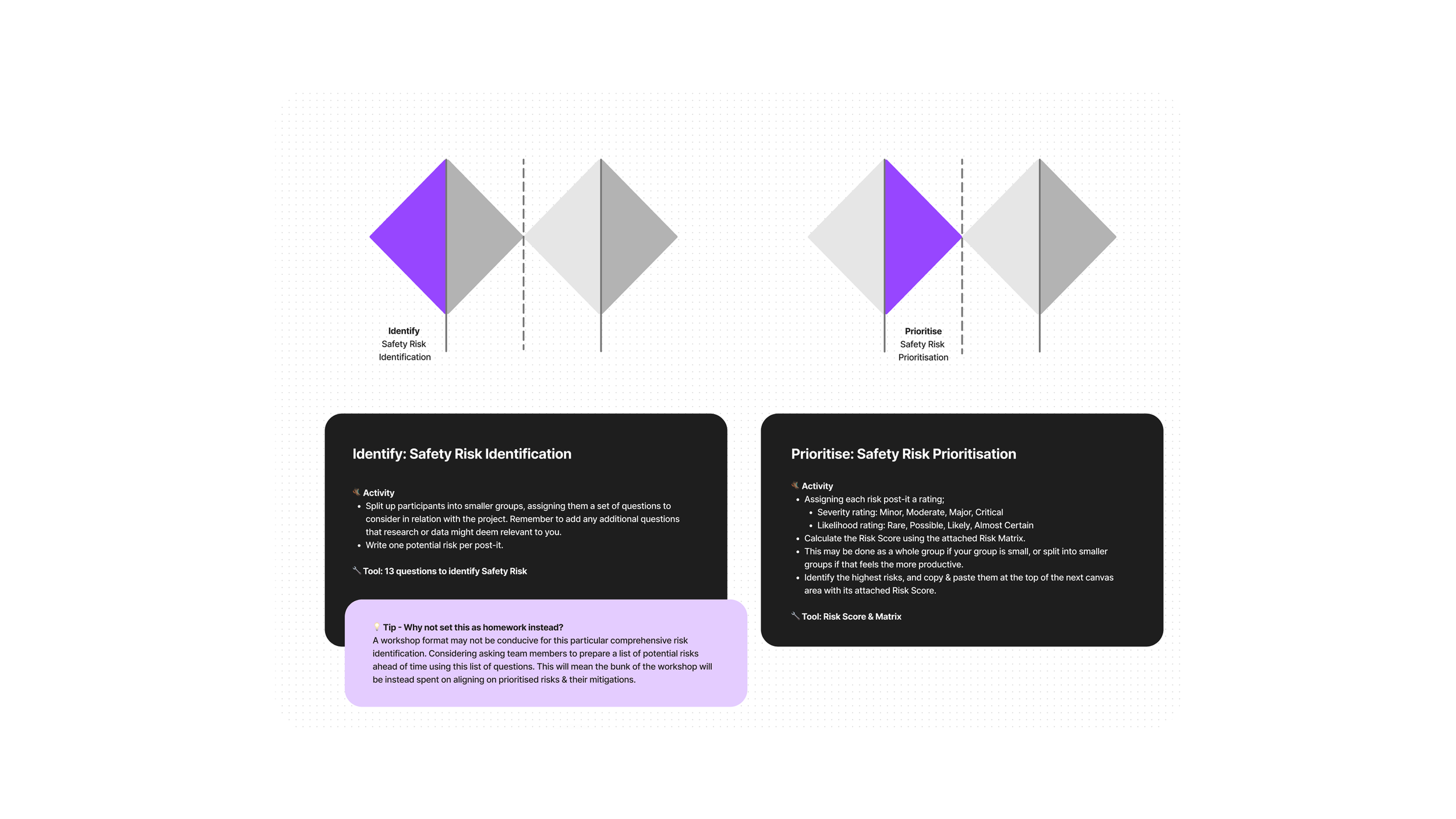
Workshop format that helps teams identify and mitigate against Safety Risks in their feature or product. This workshop employs the usual ‘diverge’ and ‘converge’ dynamics of other workshops, but has a distinctly Safety Risk angle to it.
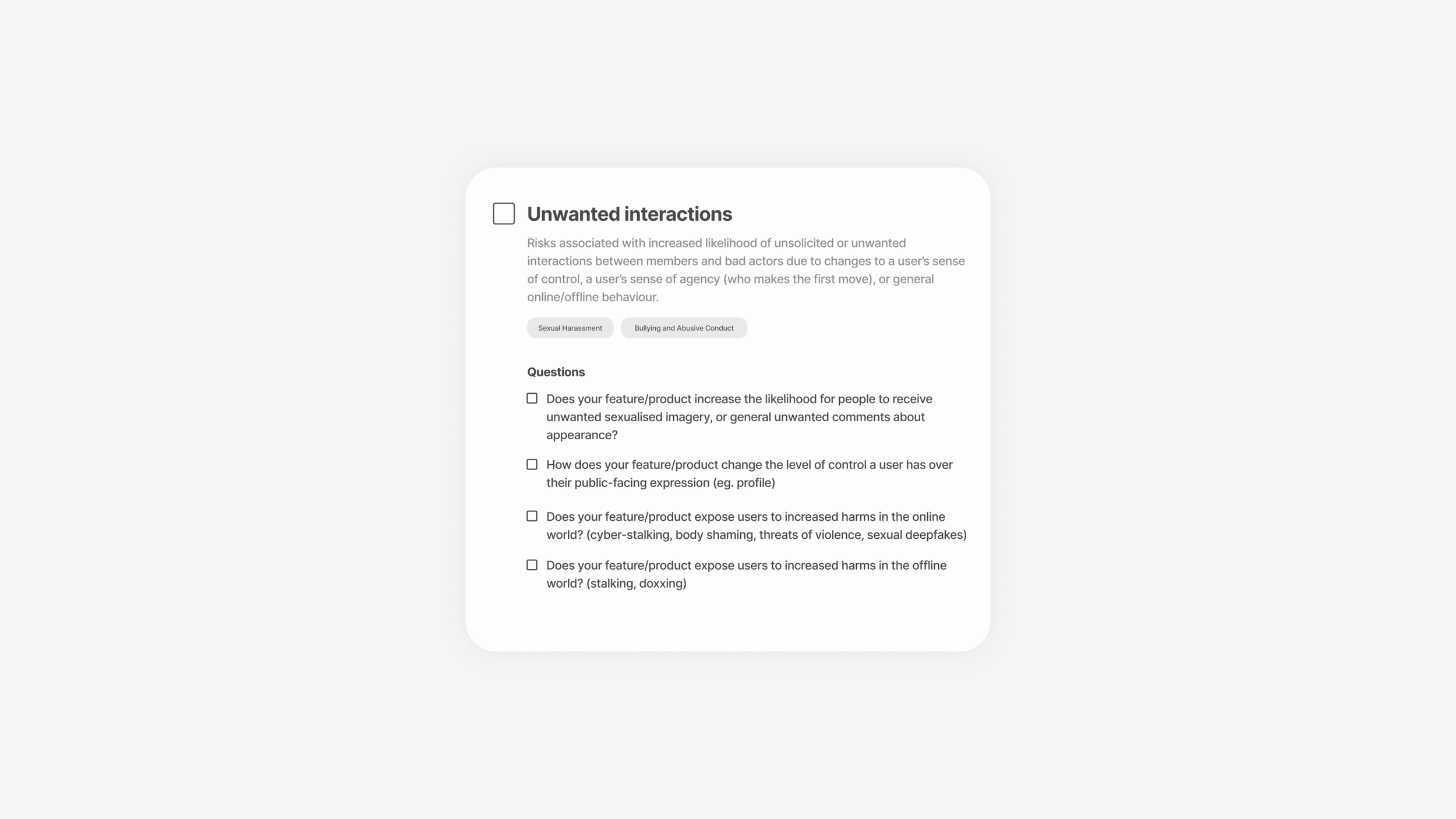
The innovative aspect of this tool was its use of Bumble Inc.’s own Trust & Safety policy as a foundation, transforming it into a repeatable & structured set of proactive questions. This created a more objective framework for teams to assess potential risks and considerations as they developed new features and projects, rather than relying on ad hoc judgement.
—
Note: This discovery and programme development took place across 2023–24, at the same time that custom and enterprise GPTs and similar tools were beginning to see broader adoption. If approached today, the method for identifying problems and opportunities would remain largely the same. However, the solutions and tooling would likely lean more heavily on AI-driven approaches.
Outcome
Resource availability
The tools were integrated into an internal platform to make them easily accessible to teams. During development, a pilot programme was conducted with Bumble product teams, covering both the Safety Evaluation and the Safety Risk Workshop.
Learnings
Findings highlighted the effectiveness of using policy-based questions as a structured approach to identifying risk. They also pointed to a need for more real-world examples of safety mitigations and features, to help teams better translate principles into practical implementation.